
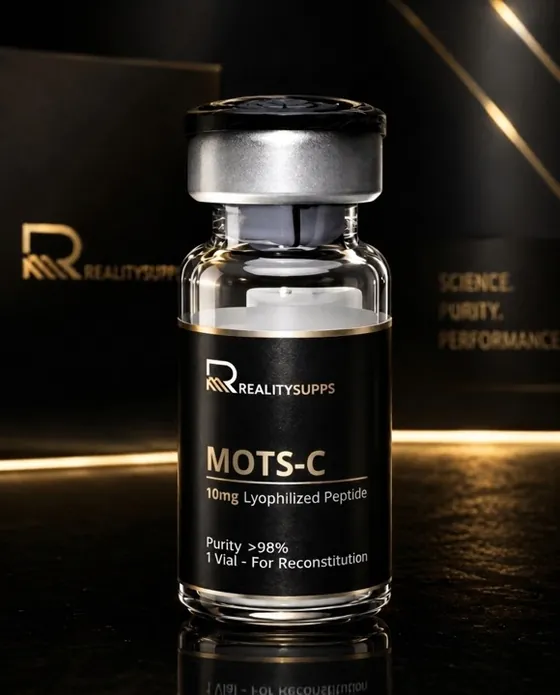
MOTS‑C
- PurityHow much of the powder is the actual compound, shown as a percent.≥98% HPLCA lab test that measures how pure a sample is., per lot
- TestingIndependent lab, every lotThe batch a vial was made in. The number is printed on the vial.
- StorageSealed, −20 °C
Ships same day before 2 PM ET · Free US shipping over $150 · Shipping & returns →
Encoded in mitochondrial DNA; studied in cell and animal models for AMPKA cell protein that tracks how much energy the cell has left. signaling.
What does this mean? (plain English)
This is a tiny peptide whose code sits in the cell's own energy-making parts (mitochondria), not in the main DNA. In animal studies, it was reported to prevent weight gain and insulin resistance (cells reacting less to the hormone that lowers blood sugar) on a high-fat diet. It also improved running ability in young, middle-aged and old animals. In people, its natural levels in muscle and blood were reported to rise after exercise. Research use only.
Every lot is independently tested. Your order's certificate comes with your lot number — look it up anytime on the Certificates page.
What it is
This is a tiny peptide whose code sits in the cell's own energy-making parts (mitochondria), not in the main DNA. In animal studies, it was reported to prevent weight gain and insulin resistance (cells reacting less to the hormone that lowers blood sugar) on a high-fat diet. It also improved running ability in young, middle-aged and old animals. In people, its natural levels in muscle and blood were reported to rise after exercise. Research use only.
A 16-amino-acid peptide encoded by a short open reading frame in the mitochondrial 12S rRNA gene, reported in 2015. In cell studies it inhibited the folate cycle and linked de novo purine synthesis, leading to AMPK activation, with skeletal muscle as its main apparent target; in mice it prevented high-fat-diet-induced obesity and insulin resistance and age-dependent insulin resistance (Lee 2015). Under metabolic stress it moved into the nucleus and regulated nuclear genes, including antioxidant-response genes, in an AMPK-dependent manner (Kim 2018). Treatment enhanced physical performance in young, middle-aged and old mice, and in humans exercise raised endogenous MOTS-c in muscle and circulation (Reynolds 2021).
Evidence level
Preclinical: cell and animal studies
Regulatory note
Not an approved drug. Sold here for laboratory research only.
Published research has examined
- AMPK activation in cell culture
- Folate–methionine pathway interactions
- Animal metabolic models (Lee 2015)
Specification
| Form | LyophilizedFreeze-dried into a dry powder. powder, 3 mL glass vial, crimp cap |
| Purity | ≥98% by HPLC, per lot |
| Storage | Sealed at −20 °C, protect from light |
| Certificate | Per lot, see Certificates |
Sources
Related compounds in Mitochondrial & cellular
Research topics: Metabolic health and glucose regulation research
Research use only. Not for human or animal consumption. Notes summarize published in‑vitro and animal research and are not claims about effects in humans or animals.