
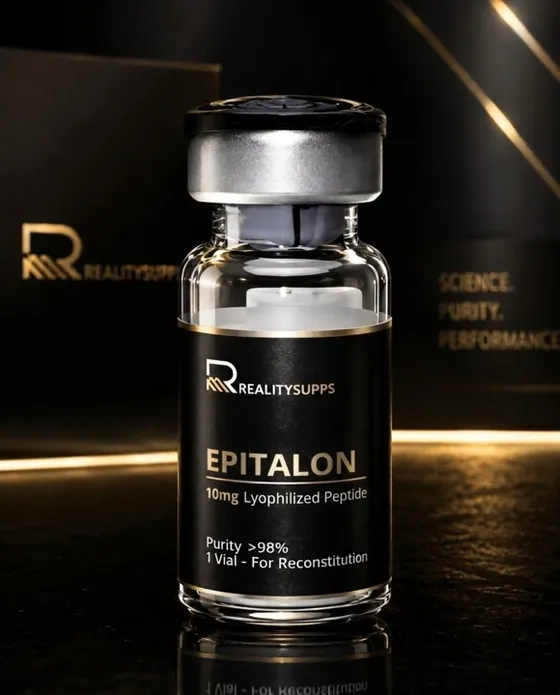
Epitalon
- PurityHow much of the powder is the actual compound, shown as a percent.≥98% HPLCA lab test that measures how pure a sample is., per lot
- TestingIndependent lab, every lotThe batch a vial was made in. The number is printed on the vial.
- StorageSealed, −20 °C
Ships same day before 2 PM ET · Free US shipping over $150 · Shipping & returns →
Studied in human fibroblast culture for telomerase‑associated activity.
What does this mean? (plain English)
This is a very small lab-made peptideA short chain of amino acids, the building blocks of proteins. first developed in Russia, based on an extract from the pineal gland in the brain. In cell studies, it switched on telomerase, an enzyme that rebuilds the protective caps on the ends of DNA (telomeres), and those caps grew longer. A separate lab in the UK reported a similar result in 2025. A 2026 review concluded it is active in the lab but unproven in people. Research use only.
Every lot is independently tested. Your order's certificate comes with your lot number — look it up anytime on the Certificates page.
What it is
This is a very small lab-made peptideA short chain of amino acids, the building blocks of proteins. first developed in Russia, based on an extract from the pineal gland in the brain. In cell studies, it switched on telomerase, an enzyme that rebuilds the protective caps on the ends of DNA (telomeres), and those caps grew longer. A separate lab in the UK reported a similar result in 2025. A 2026 review concluded it is active in the lab but unproven in people. Research use only.
A synthetic tetrapeptide (Ala-Glu-Asp-Gly) developed at the St. Petersburg Institute of Bioregulation and Gerontology from the amino-acid composition of the pineal extract epithalamin. In telomerase-negative human fetal fibroblast culture it induced expression of the telomeraseAn enzyme that rebuilds the protective caps on the ends of DNA strands. catalytic subunit, telomerase activity and telomere elongation (Khavinson 2003); an independent group reported dose-dependent telomere lengthening via hTERT up-regulation in normal cells and via ALT activation in breast-cancer cell lines (Al-Dulaimi 2025). A 2026 review judged it biologically active but clinically unproven, with no adequately powered randomized trial (Jain 2026).
Evidence level
Preclinical: cell-culture and animal studies, largely from a small number of research groups
Regulatory note
Not an approved drug in the United States. Sold here for laboratory research only.
Published research has examined
- Telomerase activity in human fibroblast culture (Khavinson 2003)
- Pineal and circadian signaling in animal models
- Four‑residue sequence Ala‑Glu‑Asp‑Gly
Specification
| Form | LyophilizedFreeze-dried into a dry powder. powder, 3 mL glass vial, crimp cap |
| Purity | ≥98% by HPLC, per lot |
| Storage | Sealed at −20 °C, protect from light |
| Certificate | Per lot, see Certificates |
Sources
Related compounds in Mitochondrial & cellular
Research topics: Healthy-aging research
Research use only. Not for human or animal consumption. Notes summarize published in‑vitro and animal research and are not claims about effects in humans or animals.